
Drip irrigation puts water directly at the root zone through low-flow emitters, at a rate the soil can absorb, with nothing thrown into the air and nothing landing on pavement. In Tucson — a Sonoran Desert city whose water utility sits in Tier 2 of its drought plan — it is both the most efficient way to water a landscape and the simplest way to stay clear of the city’s runoff rules.
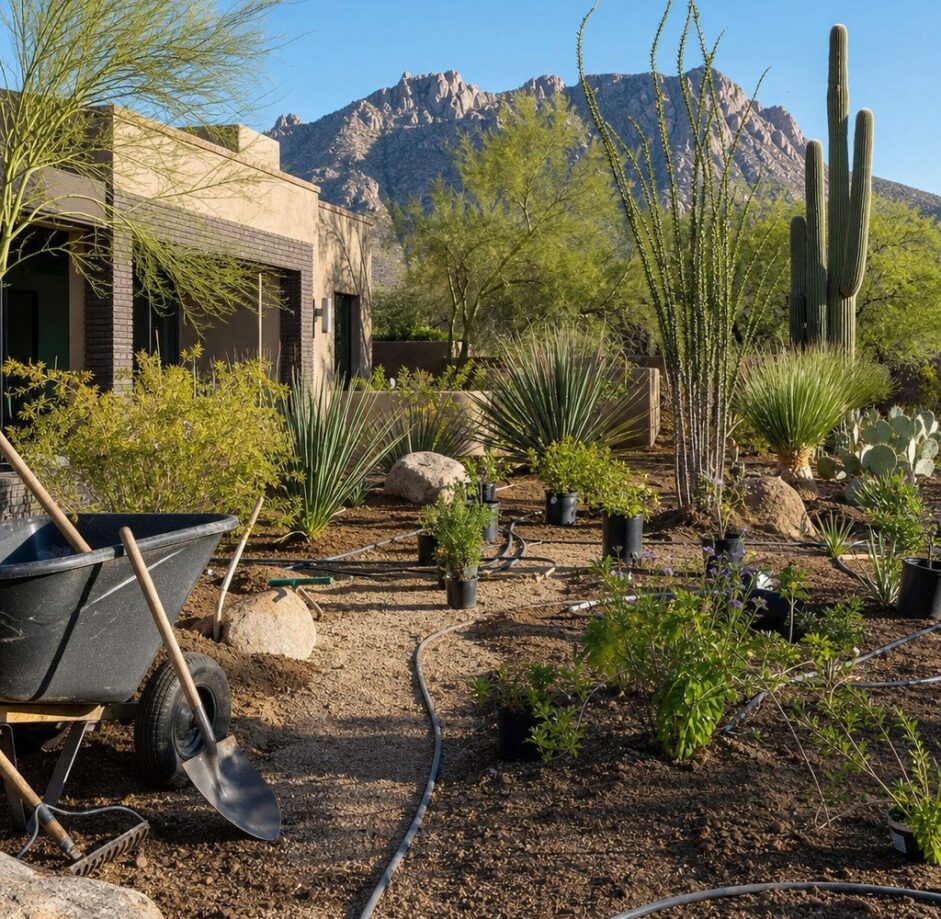
Tucson Water is in Tier 2 of its Drought Preparedness and Response Plan, declared when Lake Mead falls below 1,045 feet, and the city’s year-round water-waste rules prohibit daytime sprinkler runoff onto streets. Sprinklers are the mechanism those rules exist to address: a head slightly out of alignment, or a cycle applying water faster than the ground can take it, puts water across a sidewalk or into a gutter. Drip has no spray to misdirect and applies water slowly enough that it soaks in rather than sheets off.
Efficiency matters just as much. Desert air is aggressive with airborne water — a meaningful fraction of what a sprinkler throws never reaches the soil at all. Drip eliminates that loss and applies water only where a plant can use it, rather than uniformly across ground that grows nothing but weeds.
The Unified Development Code points the same direction, requiring efficient irrigation alongside drought-tolerant planting for new commercial and multifamily landscapes. Drip is the standard answer to that requirement.
What a drip system consists of
Tucson connection review. Verify the approved supply connection and any required protective device with Tucson Water or the applicable authority before work begins, then assign inspection responsibility in the written estimate. Tucson water-waste rules prohibit irrigation runoff onto streets, so commissioning must document where every active zone discharges.
Tucson filtration and pressure record. Record inlet pressure and source type; then choose filtration, regulation, and emitters as one documented assembly. Keep zone flow, controller settings, service access, and final runoff checks as separate acceptance items instead of relying on a copied component promise.
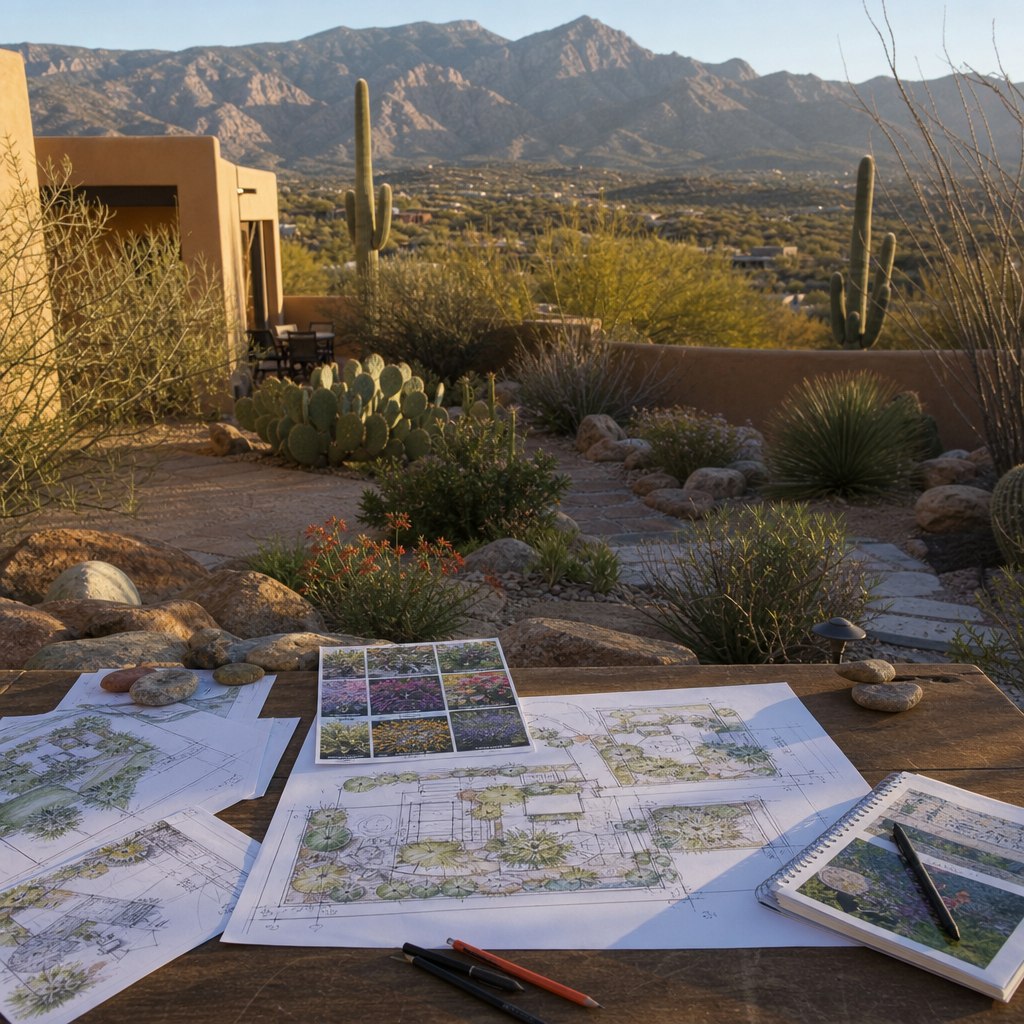
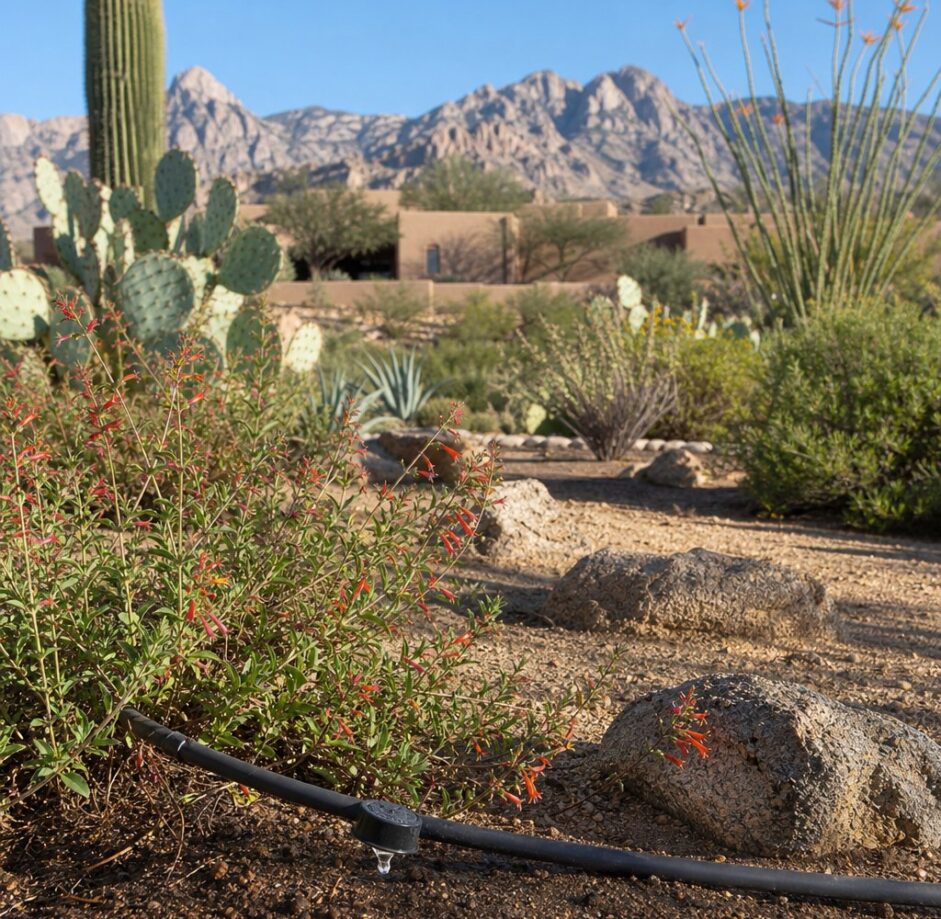
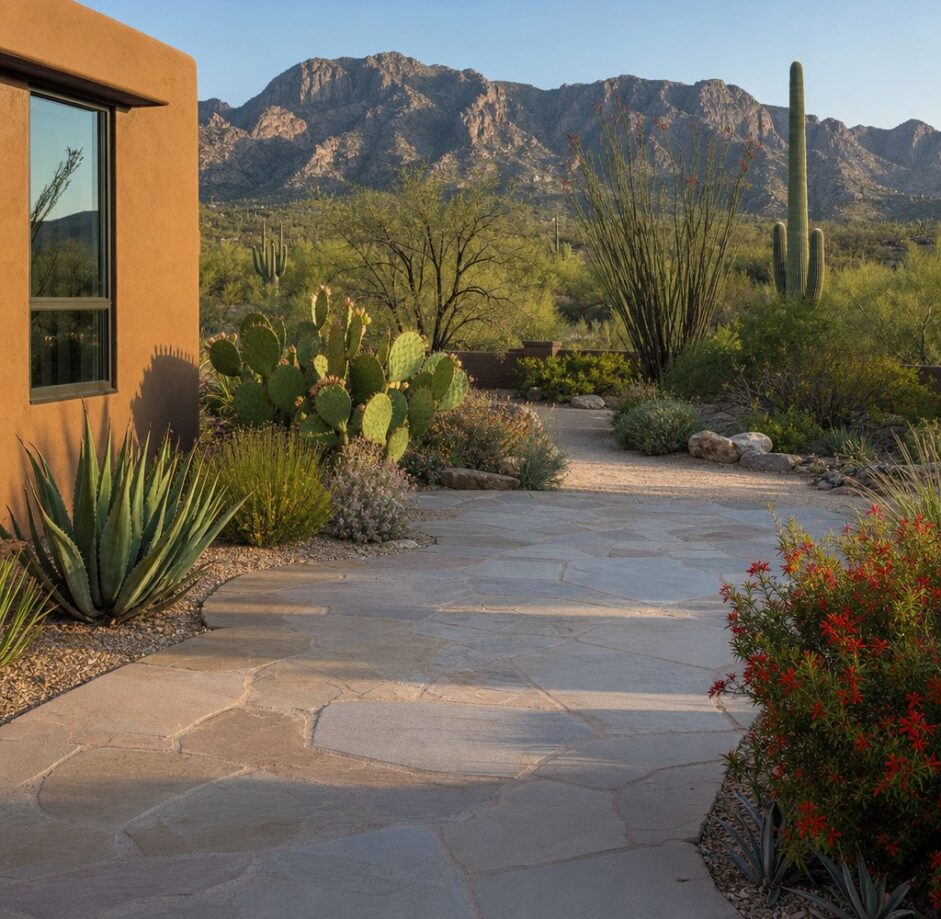
Tubing and emitters. Main line runs the length of a bed, with feeder tubing to individual plants. Emitters are rated by flow, so plants with different requirements can share a line and still receive appropriate amounts.
Zones and controller. Plants with genuinely different needs belong on separate zones, each with its own run time. The controller then executes that schedule reliably, which is the part manual watering never manages through a Tucson summer.
Getting the schedule right
Most water wasted by an efficient system is wasted by scheduling. The instinct is to water little and often; the desert rewards the opposite. Deep, infrequent cycles wet the full root depth and drive roots downward, and deep roots are what carry a plant through June. Frequent shallow watering produces shallow roots and a plant that cannot survive a missed cycle.
Seasonal adjustment matters as much as zoning. A schedule appropriate to May is wrong in January, and a controller left on summer settings through winter wastes water continuously and invisibly. If a lawn is part of the property, the seasonal contrast is sharper still: University of Arizona Extension guidance notes that between November and May, winter turf may need something in the range of half an inch to an inch and a half of water per week — a genuine ongoing requirement across the cool season, and a good reason to keep any remaining turf area on its own zone.
Cost depends on the area covered, the number of zones, the count and type of emitters, whether this is a new installation or a retrofit of existing sprinkler zones, and what controller and backflow provisions are needed. Trenching adds labour, and Tucson’s caliche adds more of it — hard ground is slower to work than soft ground, and that shows up in any honest quote. Retrofits of existing zones are often quicker than new installations because valves and supply lines are already in place. We quote after seeing the site.
Timeline
A residential installation or sprinkler-to-drip conversion is usually finished in one to a few days, depending on zone count and trenching. Commissioning is part of the job: every zone is run, every emitter checked, and the controller programmed and explained before we leave.
Drip is the right tool for beds, desert plantings, shrubs, cacti, and trees — effectively everything in a converted Tucson yard. It is not the right tool for a genuine turf area, which needs uniform coverage across a continuous surface. Many properties run both: drip everywhere planted, conventional irrigation retained only on the lawn that is actually used.
Local constraints: Tucson Water and the UDC
Tucson Water operates in Tier 2 of that plan, the tier tied to Lake Mead falling below 1,045 feet, and year-round water-waste rules prohibit daytime sprinkler runoff onto streets. The Unified Development Code requires drought-tolerant plants and efficient irrigation for new commercial and multifamily landscapes. A correctly built drip system removes the runoff mechanism outright rather than merely reducing the risk of it. (Source: City of Tucson — Tucson Water Drought Preparedness. Checked 3 August 2026.)
Maintenance and how systems fail
Drip fails silently. A broken sprinkler announces itself with a plume; a blocked emitter simply stops delivering, and the first symptom is a dying plant weeks later. A short seasonal routine catches nearly everything: flush the lines, clean the filter, run each zone and walk it, and replace emitters that have stopped or are running freely. Tubing pulled loose by root growth or garden work is the other frequent fault — obvious while a zone is running, invisible when it is not.
Frequently asked questions
Does drip help with Tucson’s runoff rules? Yes, directly. The rules address water running onto streets from daytime sprinkler use. Drip produces no spray and applies water slowly enough to be absorbed, so there is nothing to run off.
Can you convert my sprinklers to drip? Yes. Existing zones are commonly retrofitted for beds and desert plantings, generally reusing buried supply lines and valves already in place.
How long should each zone run? Longer and less frequently than most people expect. The goal is to wet the full root depth, then allow the soil to dry before the next cycle.
Do I need to change the schedule seasonally? Yes. A summer schedule left running in winter wastes a great deal of water without anyone noticing. Seasonal adjustment is the highest-value habit in desert irrigation.
Begin a Tucson pressure-regulator question with site-specific observations, measurements, photographs, access information, and priorities. Obtain a written account of evaluation, options, limits, dependencies, charges, and final authorization.
Will I see the tubing? It is normally run beneath the granite or mulch layer, so the finished bed shows plants and ground cover rather than hardware.
Sources
City of Tucson — Tucson Water conservation and landscape resources: tucsonaz.gov. University of Arizona Cooperative Extension — turfgrass maintenance guide for the low-elevation Arizona desert (az1817): extension.arizona.edu.
Map a drip-irrigation correction from the Sonoran hydrozone map
Get a Free Quote
Share the Tucson sun, runoff, irrigation, and space-use details.
Tell Us About Your Sonoran Site Before Pricing
Send the sun, runoff, irrigation, access, and use notes that define the proposed Tucson work area and priorities.
Get a Free QuoteFrequently Asked Questions
Where should a Tucson drip irrigation tucson site walk look for compacted ground?
Probe the proposed work area, especially along old paths, wall edges and places where water stalls or sheets away. The observation should be recorded by location so drip irrigation tucson preparation responds to this lot rather than a general soil label.
How can monsoon runoff change the Tucson drip irrigation tucson layout?
Map flow paths, low points and discharge near walls before fixing grades or material boundaries. The layout should preserve safe drainage and identify any condition that needs separate evaluation instead of hiding it inside the finish work.
Which decisions belong after the Tucson property walk?
Final preparation depth, drainage treatment, irrigation changes and access method depend on what is found in the work area. A drip irrigation tucson proposal should keep those items conditional until the site evidence supports them.