
Tucson Yard Works handles scheduled commercial grounds care in Tucson and across Pima County: desert beds, turf strips, trees, parking lot islands and storm cleanup. We quote each property after walking it, because lot size, turf and tree count drive the price. Call (520) 495-2146 or request a free quote.
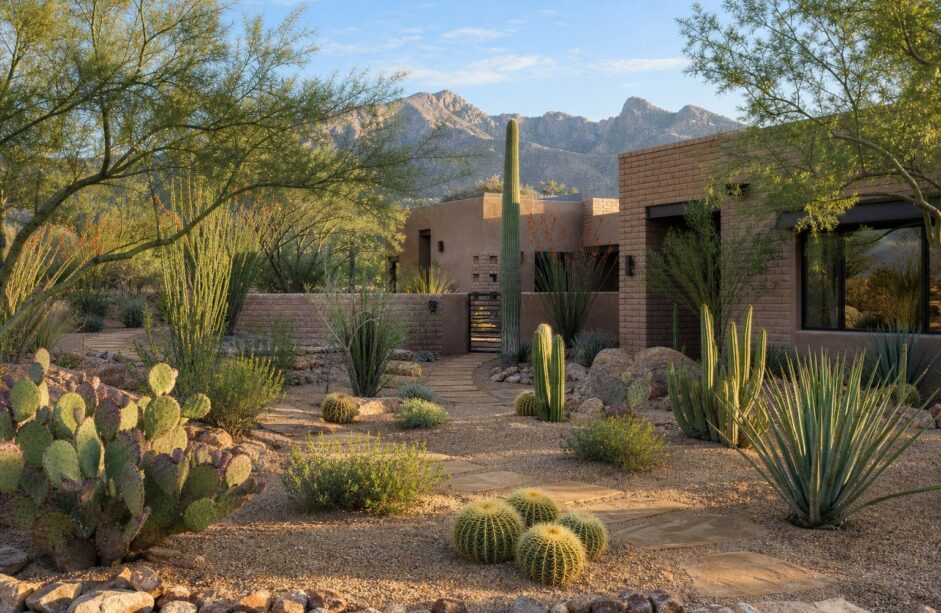
This page is written for property managers, HOA boards, office owners and anyone who has inherited a landscape contract and wants to know what a Tucson grounds crew should actually be doing. We are a residential and light commercial outfit, so we say plainly where our scope stops. We don’t install irrigation systems and we don’t build hardscape, and we won’t quote them. What we do is keep what is already on the ground alive, tidy and defensible under Tucson’s water rules.
What does commercial landscaping in Tucson actually include?
For us it means recurring grounds maintenance on a commercial or association property: weed control in decomposed granite, shrub and groundcover pruning, turf mowing where turf exists, tree trimming, debris removal, and irrigation checks reported back to you. Construction, irrigation installation and hardscape are outside what we sell.
A typical visit has a written scope behind it, so you can see what each pass was supposed to cover. The list below is how we split a property into line items before anyone quotes a number.
- Granite and gravel areas. Raking back to level, weed removal, and topping up thin spots after storms.
- Planting beds. Selective pruning of shrubs, cutting back spent flower stalks, clearing dead growth from agave, yucca and groundcovers.
- Turf strips and lawns. Mowing, edging and trimming along walks and curbs where a property still carries bermudagrass.
- Trees. Deadwood removal, clearance over walkways, signs, light poles and parking stalls, and a note on anything that needs a specialist.
- Water basins and drainage swales. Cleared of silt and debris so the next storm is absorbed rather than shed into the lot.
- Irrigation observation. We run zones, look for broken heads, pooling and overspray, and report what we find. Repairs to buried lines go through whoever holds your irrigation work.
- Hauling. Green waste leaves with the crew. Nothing is stacked behind the dumpster enclosure.
How much does commercial landscaping cost in Tucson?
We don’t publish a per-square-foot figure, because three properties of the same acreage can differ by a factor of three in labor. Quotes are built from visit frequency, turf and tree count, how overgrown the site is today, and hauling. We price after a walk-through and put the line items in writing.
The drivers that move a commercial quote most are worth knowing before you collect bids, so you can compare them fairly:
- Frequency. A weekly or biweekly visit keeps each pass small. A property seen once a quarter is mostly reclamation work every time.
- Turf versus granite. Turf means weekly mowing in the growing season. A granite and desert plant property is lighter on routine labor but heavier on weed work after monsoon.
- Tree count and height. Large mesquite and palo verde canopies add real labor, and anything near overhead lines is not ours to cut.
- Access. Gates, tenant parking hours and loading zones decide when a crew can be on site and how long equipment sits.
- Starting condition. A site that was left for a year is priced as a one time reset first, then routine visits.
Our own Tucson landscaping cost guide covers the Tucson Water rebate figures that sometimes offset a rainwater or gray water project on a property. It is not a service price list, and we say so on the page itself.
Who handles commercial grounds in Tucson, and how soon can a crew start?
We take on commercial and association properties across the Tucson metro, from office courtyards to Oro Valley, Marana and Sahuarita sites. After a walk-through and a written scope you approve, a crew can usually be scheduled on the next open route. Start dates depend on the season and our current route load.
We would rather tell you a realistic start date than a fast one. April through June and the weeks right after monsoon storms are the busiest. If a property is a safety or access problem right now, say so in the first call and we will tell you whether we can reach it ahead of the regular route.
What does our commercial maintenance process look like, step by step?
The work moves in six steps: a walk-through, a written scope and quote, a first reset visit, a routine schedule, a visit summary after each pass, and a seasonal review. You approve the scope before work starts, and you decide what gets added, trimmed from the plan or deferred.
- Walk-through. We walk the whole site with whoever manages it, photograph problem areas, and note gates, hours and utilities. You decide what matters most, for example entry monument beds or a failing parking lot island. This takes an hour or two for a typical center.
- Written scope and quote. We split the property into line items: granite, beds, turf, trees, basins, hauling. You decide which items go on the recurring plan and which are one time work. Expect this within a few business days of the walk-through.
- Reset visit. If the site is behind, the first visit brings it to a baseline: weeds cleared, beds cut back, basins reformed, debris out. Large or badly overgrown sites are staged over more than one day.
- Recurring visits. Weekly, biweekly or monthly, depending on turf and the season. Turf properties are mowed weekly through the growing season, while granite properties often run lighter schedules.
- Visit summary. After each pass you get a short note: what was done, what was seen, and anything that needs your decision such as a leaking head, a dying tree or a rutted basin.
- Seasonal review. Before monsoon and again after it, we walk the site against the original scope and adjust frequency and line items to what the property actually needed.
How does the monsoon change a commercial landscape schedule?
Monsoon storms strip leaves and small limbs, move decomposed granite out of position, silt up water basins and trigger a weed flush within days. A pre-storm pass clears loose material and checks drainage. A post-storm pass catches the germination wave before it seeds and puts basins and granite back.
Rain isn’t the only effect. Organic matter carried in by wind and water settles on top of granite and, over a season or two, builds a thin soil layer above the weed barrier. Weeds then root in that layer rather than in the ground below it. On a commercial property that shows up first in the hardest to reach spots: the corners of parking islands, the strip between a wall and a walk, and the beds at a dumpster enclosure.
We build monsoon timing into recurring schedules instead of selling it as an emergency. If your contract has an even monthly rhythm through July, August and September, it probably gets the roughest weeks wrong. A heavier visit right after a major storm and a lighter one beforehand usually keeps the site tidier for the same total labor.
What changes for a commercial property that still has turf?
Turf makes the schedule heavier and more seasonal. University of Arizona Extension advises mowing bermudagrass at least once a week through the growing season. Overseeded winter grass is a separate set of dates and costs, so decide each year whether it is worth doing on your property.
Extension’s low desert turf guide describes bermudagrass as vigorous in summer and dormant in winter, going blonde after several frosty nights in November or December. That is why many commercial sites overseed with ryegrass. For higher elevation Tucson the guide gives a seeding window of September 25 to October 5, and it says cultivation such as aerating belongs in June through August, not right before overseeding.
If a turf strip is only decoration, a conversation about reducing it is worth having before you pay to overseed it again. If it is the one area tenants use, we schedule mowing, edging and the seasonal passes in the written plan so the cost shows up as a line you can see. Our Tucson landscaping calendar shows how the seasons line up.
What do Tucson’s water rules mean for a commercial property?
Tucson sets no assigned watering days or hours. Its Water Waste Ordinance, in force since 1984, targets where water ends up. For commercial sites that means no water escaping onto streets or neighbors, ponding in a parking lot no deeper than a quarter inch, and no hosing down pavement with a pressurized nozzle.
Several of the six violations bite commercial properties harder than homes. Washing driveways, sidewalks and parking areas with an open hose under pressure is a violation, and the residential exception does not cover a commercial customer. Misting systems running in unoccupied non-residential areas are also a violation. Ponding in a parking lot counts once it is deeper than one quarter inch or covers more than 150 square feet in total.
Irrigation heads that spray more than ten percent of their output onto a street, parking lot or sidewalk are a violation as well, but only where the head was designed to deliver more than one gallon per hour. A broken head or a controllable leak left unrepaired is its own violation. Our Tucson watering rules page lays out all six with the thresholds, as read from Tucson Water.
For a grounds crew the practical meaning is simple. We look at every zone while the yard is clear, flag any spray on pavement, and tell you which items are your irrigation contractor’s problem. Tucson Water states that a warning is usually the first step and a citation follows if the problem isn’t corrected, so a flagged head that sits for a month is the expensive kind of finding.
Can a commercial property plant or remove anything in the city right of way?
Only with the city’s approval. Tucson’s Transportation and Mobility department says planting in the public right of way needs approval of the planting plan by its landscape architect and a right of way permit. Removing vegetation there requires first calling the city to find out who owns it.
The city’s published commercial property guidance is worth reading before any change to a street frontage bed. It says a required landscape bufferyard belongs on your site, and in special cases up to five feet of it may sit inside the right of way if there is a site constraint that prevents placing it on site. Utilities and sight visibility triangles must appear on the plans. The city may also remove right of way landscaping to build or repair facilities and will not replace it.
Where the city built the landscape, has an irrigation system and maintains the area, the plants are a city asset, and removing them without approval is treated as destroying government property. That is a rule about the property, not a service we offer, but it matters when a frontage bed looks like ours to prune. If you aren’t sure whose bed it is, ask first. Our project approvals guide explains how to keep zoning and permit questions in separate columns.
What is it about Tucson soil and climate that changes commercial plant care?
Tucson sits in USDA zones 9a and 9b, and local soils such as the Mohave series run neutral near the surface and moderately alkaline below, with a hard calcic layer documented at 20 to 40 inches. Water can sit above that layer, so watering depth and basin shape matter.
That layer is the reason a tree planted without checking depth can sit in a bowl that holds water, and why a basin dug to the wrong depth fails. When we walk a property we note where water collects and where it disappears, and we put those spots on the scope. Our soil and site guide explains what a proper site record includes.
Heat is the other constant. Summer pruning and cleanup are done early in the day, and plants on west facing walls get a different watering assessment than the same plant in a shaded courtyard. If you manage buildings with a lot of reflected heat off glass or stucco, tell us in the walk-through. It changes which plants we flag as at risk.
What does a typical commercial job look like?
Scopes vary a lot between sites, so here are three typical ones with the line items we would write for each. These are illustrations of how we scope, not descriptions of completed jobs, and they carry no prices because every site is quoted individually after a walk-through.
A typical small office park with granite beds
Four buildings on a shared lot, decomposed granite throughout, twenty or so desert trees, no turf. Monthly routine visits with weed control and bed cleanup, a pre-monsoon trim of trees over walkways, a post-storm visit for debris and basin repair, and an irrigation zone check each quarter with a written note on findings. Most of the labor is weeds and debris, so the schedule leans toward more frequent but lighter passes in July through September.
A typical retail strip with turf islands and street frontage
A single row of storefronts, a parking lot with planted islands and a street frontage bed. Weekly mowing and edging on the turf islands in growing season, biweekly in winter if overseeded, monthly pruning of shrubs at the entry, and a separate line for any frontage bed that sits in the right of way, confirmed with the city before we touch it. Irrigation checks follow the six violations: we look at overspray onto the street and pavement ponding first.
A typical association entry and common area
An entry monument, a mailbox cluster, a small park with a few mature trees and a basin. Seasonal pruning on the entry plantings, tree deadwood removal before monsoon, basin reshaping after the heaviest storm, and a yearly review of what the property needs. This type of site usually gets a lighter visit rhythm with heavier seasonal passes.
Which neighborhoods and suburbs do we cover for commercial work?
We work across the Tucson metro and the surrounding communities, including Oro Valley, Marana, Sahuarita, Catalina Foothills, Tanque Verde, Flowing Wells and Green Valley. Travel time affects route planning, so a property at the edge of the service area may be scheduled on set days rather than any day of the week.
Each area has its own character. Our pages for Oro Valley, Marana, Sahuarita, Catalina Foothills and Tanque Verde describe the conditions we see there. If your property sits in another part of Pima County, the full list is on our areas page, and a call will tell you faster than a map.
How do tree trimming and cleanup fit into a commercial plan?
They are separate line items on the same schedule. Tree work is priced by tree, height and access, and cleanup by site size and debris volume. Combining them on one route saves a mobilization, and you can approve each separately so there is no surprise on the invoice.
If trees are your main concern, see our tree trimming page, which explains pre-monsoon structural work and what we leave to the electric utility. For storm debris and weed flush, yard cleanup explains the post-monsoon reset. Both can be added to a recurring commercial plan.
What should I ask before hiring a commercial landscaper in Tucson?
Ask for the scope in writing, line by line, with visit frequency and what happens after a storm. Ask who handles irrigation faults found during visits, what is excluded, and how hauling is handled. A quote that is one number with no breakdown can’t be compared with another bid.
Beyond that, ask each bidder the same set of questions so you compare like with like:
- What exactly is included on each visit, and what is a separate charge?
- How many weeks of the year is mowing scheduled, and what happens to the schedule in winter?
- What is the plan for the week after a major storm?
- Who tells me when something needs a decision, and how fast?
- Which jobs does the company not do, such as irrigation installation or hardscape construction?
The last question is the one that saves the most trouble. A company that is clear about its edges is easier to manage than one that says yes to everything.
How do I get a quote for my property?
Call (520) 495-2146 or use the free quote form, and tell us the property type, rough size, whether it has turf, and what is bothering you most. We then arrange a walk-through and send a written scope with line items. You approve the plan before any crew is scheduled.
It helps to have a few things ready: a site plan or aerial if you have one, any current contract so we can see what is and isn’t covered, and the name of whoever controls gate and parking access. If you are weighing us against a current provider, we are happy to price the same scope so you have a fair comparison. When you are ready, request your free quote here or call (520) 495-2146.