Desert Landscaping in Tucson, AZ
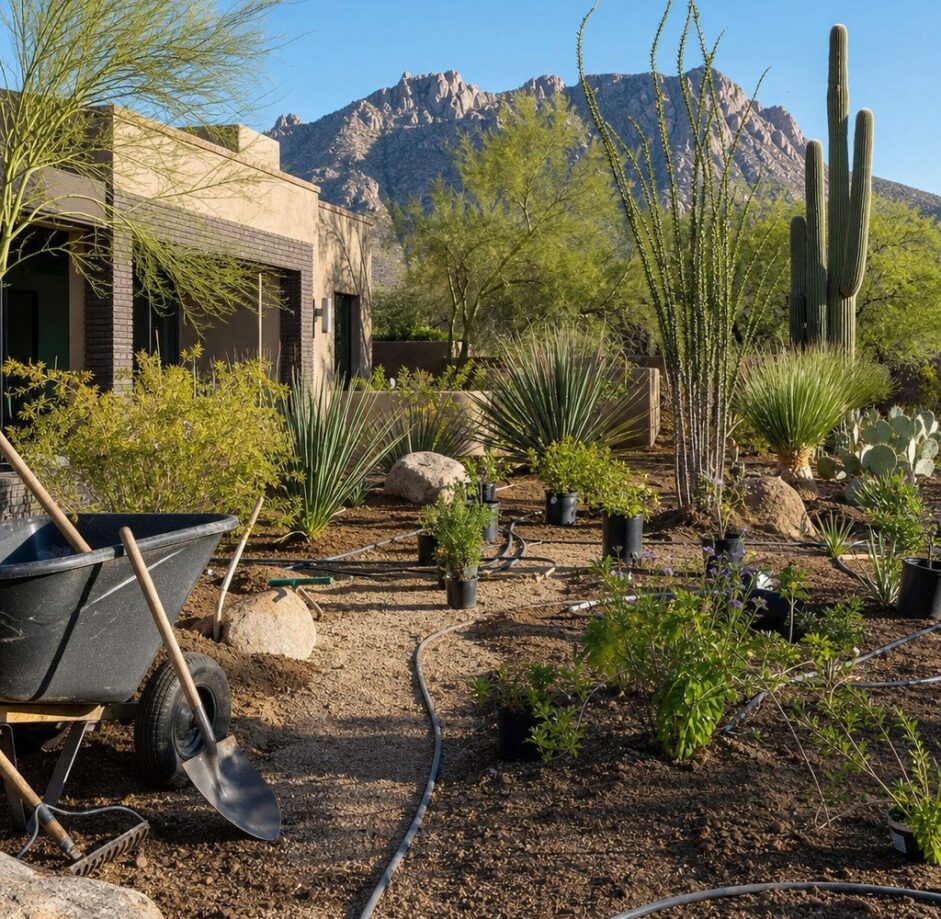
Desert landscaping replaces high-water turf with drought-adapted plants, permeable ground cover, and efficient irrigation designed for the Sonoran Desert. In Tucson it is the most sensible long-term approach to a yard: it holds its appearance through the hottest months, it survives on a fraction of the water a conventional lawn demands, and it aligns with the direction the city’s water policy has been moving for years.
Tucson Water is in Tier 2 of its Drought Preparedness and Response Plan — the tier declared when Lake Mead falls below 1,045 feet — and the city’s year-round water-waste rules prohibit daytime sprinkler runoff onto streets. Under the Unified Development Code, new commercial and multifamily landscapes are required to use drought-tolerant plants and efficient irrigation. The regulatory direction is unambiguous, and residential landscapes that already run on low water are simply not exposed to it.
The agronomy points the same way. The best-adapted lawn grass for Arizona’s low desert — which the University of Arizona Cooperative Extension’s turfgrass guidance identifies as including Tucson — is bermudagrass, chosen precisely for its heat tolerance and water requirements. But bermudagrass goes dormant and brown in winter, so a green year-round lawn means overseeding with a winter grass every autumn and watering that winter turf through the cool season as well. A desert landscape has no equivalent obligation in either season.
Removal and haul-off. Existing turf and root mass are removed rather than buried. Bermudagrass in particular regenerates from what is left behind, so incomplete removal is the most common reason a converted yard sprouts grass through its gravel a year later.
Grading for the monsoon. Tucson’s rain arrives concentrated and hard. Grading, shallow basins, and swales decide whether a summer storm waters your plants or scours your ground cover into the street. This is the step that separates a landscape that improves with each monsoon from one that degrades.
Irrigation. Drip lines are laid out by plant water requirement and zoned so that establishing plants and mature ones are not sharing a schedule.
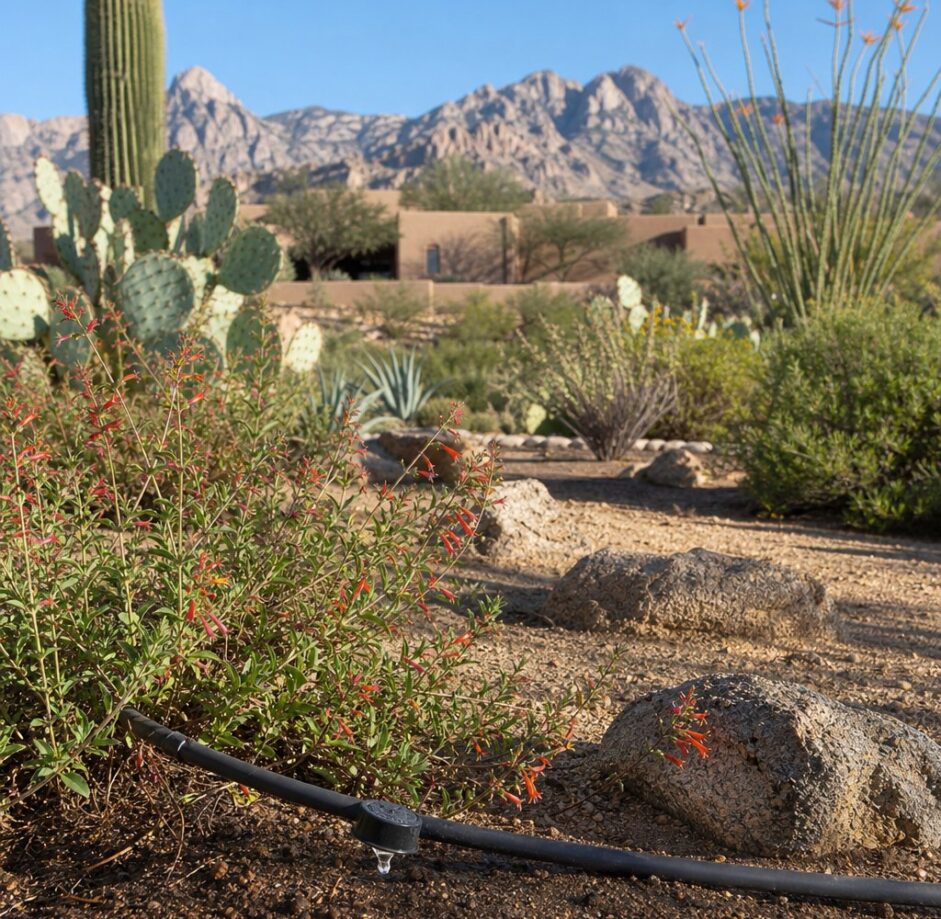
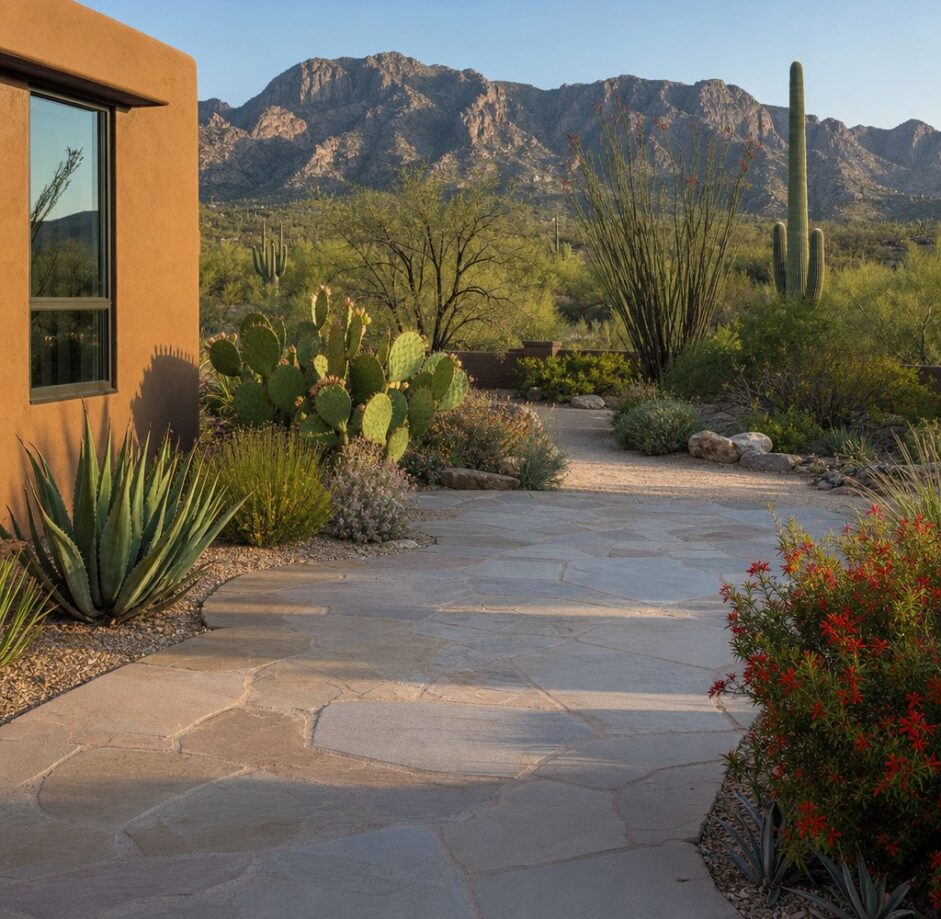
Edging and ground cover. Edging holds the boundary between materials. Decomposed granite or gravel is placed at a depth that genuinely suppresses germination rather than merely covering the soil.
Planting. Plants go in last, spaced for mature size, with basins formed to hold water at the root zone during establishment.
Design that works in the Sonoran Desert
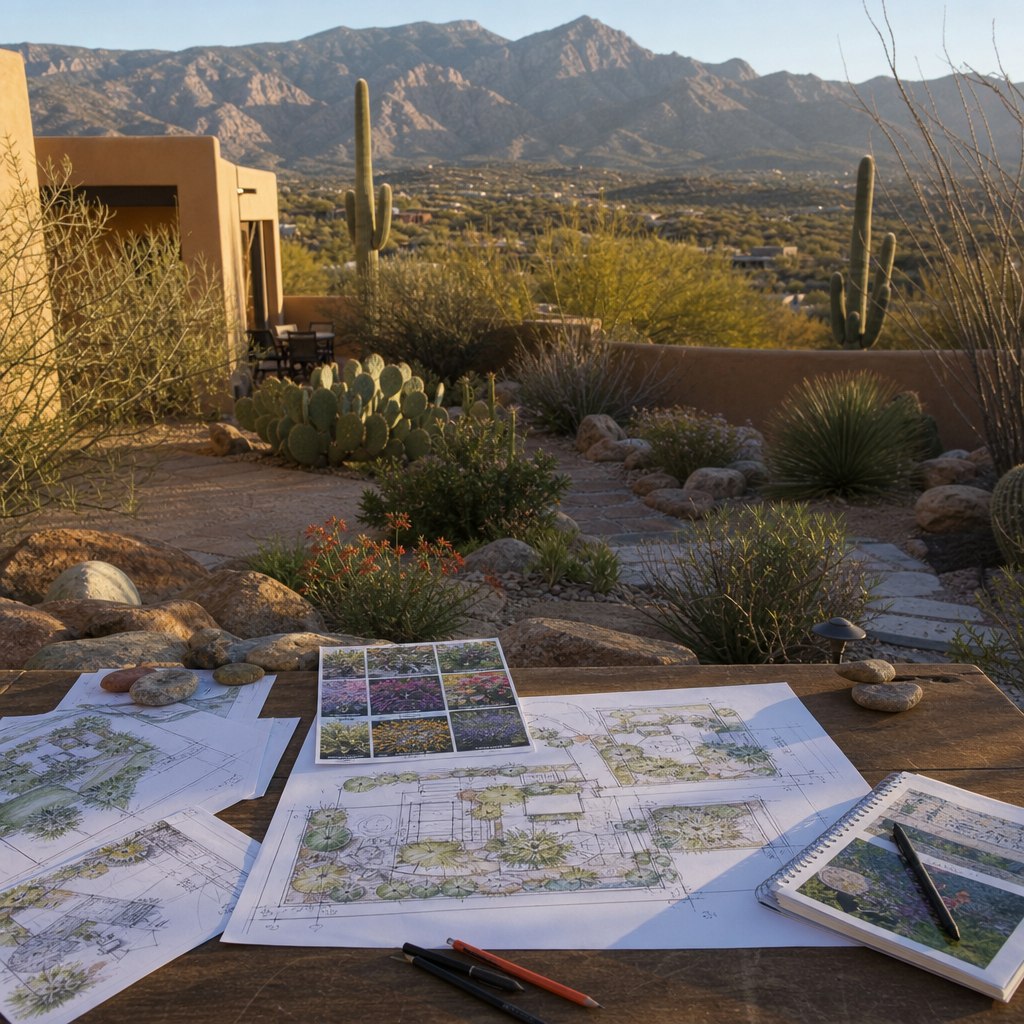
The strongest Tucson landscapes are layered and shaded rather than open and flat. Desert trees provide the canopy that makes a yard usable in summer and lowers the demand of everything planted beneath them. Structural shrubs hold the composition together year-round, and accent plants and cacti provide form and seasonal color.
An unshaded expanse of granite with a handful of plants in it is the version to avoid. It stores heat, radiates it back at the house, glares, and never looks finished. The additional water required to support genuine planting density is modest; the difference in how the yard looks and feels is not.
Cost is driven by yard size, how much turf and hardscape must be removed and hauled, the amount of grading the drainage requires, the plant and ground-cover selection, and whether irrigation is new or a conversion of an existing system. Site access matters, because ground cover is heavy and every yard of it has to be moved in by whatever route exists. Rock, boulders, and custom hardscape raise the total; phasing a large conversion across seasons spreads it. We quote on site, since these variables move independently on every property.
Timeline
Most residential conversions run from a few days to a couple of weeks depending on scope, in the order of demolition, grading, irrigation, edging and ground cover, then planting. Establishment follows: new plants need consistent water through their first full season, after which their requirement drops sharply and permanently.
Desert landscaping is the right call if you want a yard that looks good in June without a large irrigation budget, and if you would rather not overseed and water a winter lawn every year to keep it green. If you have children or dogs who genuinely use a grass surface, the better answer is usually partial: keep a modest, well-irrigated turf area where it is actually used, and convert everything that exists only to be looked at.
Local constraints: Tucson Water and the UDC
Tucson Water is in Tier 2 of its Drought Preparedness and Response Plan, the tier tied to Lake Mead falling below 1,045 feet. The city’s year-round water-waste rules prohibit daytime sprinkler runoff onto streets, and the Unified Development Code requires new commercial and multifamily landscapes to use drought-tolerant plants and efficient irrigation. A residential desert landscape on drip meets the spirit and the substance of all of it, and removes the runoff mechanism entirely. (Source: City of Tucson — Tucson Water Drought Preparedness. Checked 3 August 2026.)
Desert landscapes need attention, just much less of it. Ground cover is topped up where it thins or where a storm has moved it, weeds are pulled before they seed, shrubs and accents are pruned annually to hold form, and emitters are checked each season for clogs and breaks. After a heavy monsoon it is worth walking the yard specifically to check that basins and swales still hold their shape.
Frequently asked questions
Does a desert landscape still need irrigation in Tucson? Yes, particularly during establishment through the first full season. Once established, desert-adapted plants need only occasional deep watering, which is a small fraction of what turf demands.
Will I still have to overseed every autumn? No. Overseeding is a bermudagrass lawn requirement — perennial ryegrass is planted into dormant bermudagrass to stay green from roughly October through May. A desert landscape has no such cycle.
Do the UDC landscape rules apply to my house? The drought-tolerant planting and efficient-irrigation requirements referenced here apply to new commercial and multifamily landscapes. Residential conversions are generally undertaken for water cost and appearance rather than obligation.
What about the monsoon — will gravel wash away? Not if the grading is right. Correct fall, basins, and edging are what keep ground cover in place. Washouts are a drainage failure, not a material failure.
Can I keep some lawn? Yes, and a partial conversion is often the best outcome. Concentrating irrigation on a small, genuinely used turf area captures most of the saving without losing the use.
Will it look bare? Only if it is under-planted. Layered trees, shrubs, accents, and cacti give a desert yard year-round structure and seasonal interest.
Sources
City of Tucson — Tucson Water conservation and landscape resources: tucsonaz.gov. University of Arizona Cooperative Extension — turfgrass maintenance guide for the low-elevation Arizona desert (az1817) and overseeding winter grasses into bermudagrass turf (az1683): extension.arizona.edu.
Plan a desert-landscape conversion from the Sonoran hydrozone map
How much does landscaping cost in Tucson?
Landscaping cost in Tucson is driven by yard size, how much turf and hardscape must be removed and hauled away, the amount of grading the drainage requires, the plant and ground-cover selection, and whether the irrigation is a new system or a conversion. Tucson Yard Works prices each of these per property.
Get a Free Quote
Share the Tucson sun, runoff, irrigation, and space-use details.
Tell Us About Your Sonoran Site Before Pricing
Send the sun, runoff, irrigation, access, and use notes that define the proposed Tucson work area and priorities.
Get a Free QuoteFrequently Asked Questions
Where should a Tucson neighborhood property planning site walk look for compacted ground?
Probe the proposed work area, especially along old paths, wall edges and places where water stalls or sheets away. The observation should be recorded by location so neighborhood property planning preparation responds to this lot rather than a general soil label.
How can monsoon runoff change the Tucson neighborhood property planning layout?
Map flow paths, low points and discharge near walls before fixing grades or material boundaries. The layout should preserve safe drainage and identify any condition that needs separate evaluation instead of hiding it inside the finish work.
Which decisions belong after the Tucson property walk?
Final preparation depth, drainage treatment, irrigation changes and access method depend on what is found in the work area. A neighborhood property planning proposal should keep those items conditional until the site evidence supports them.